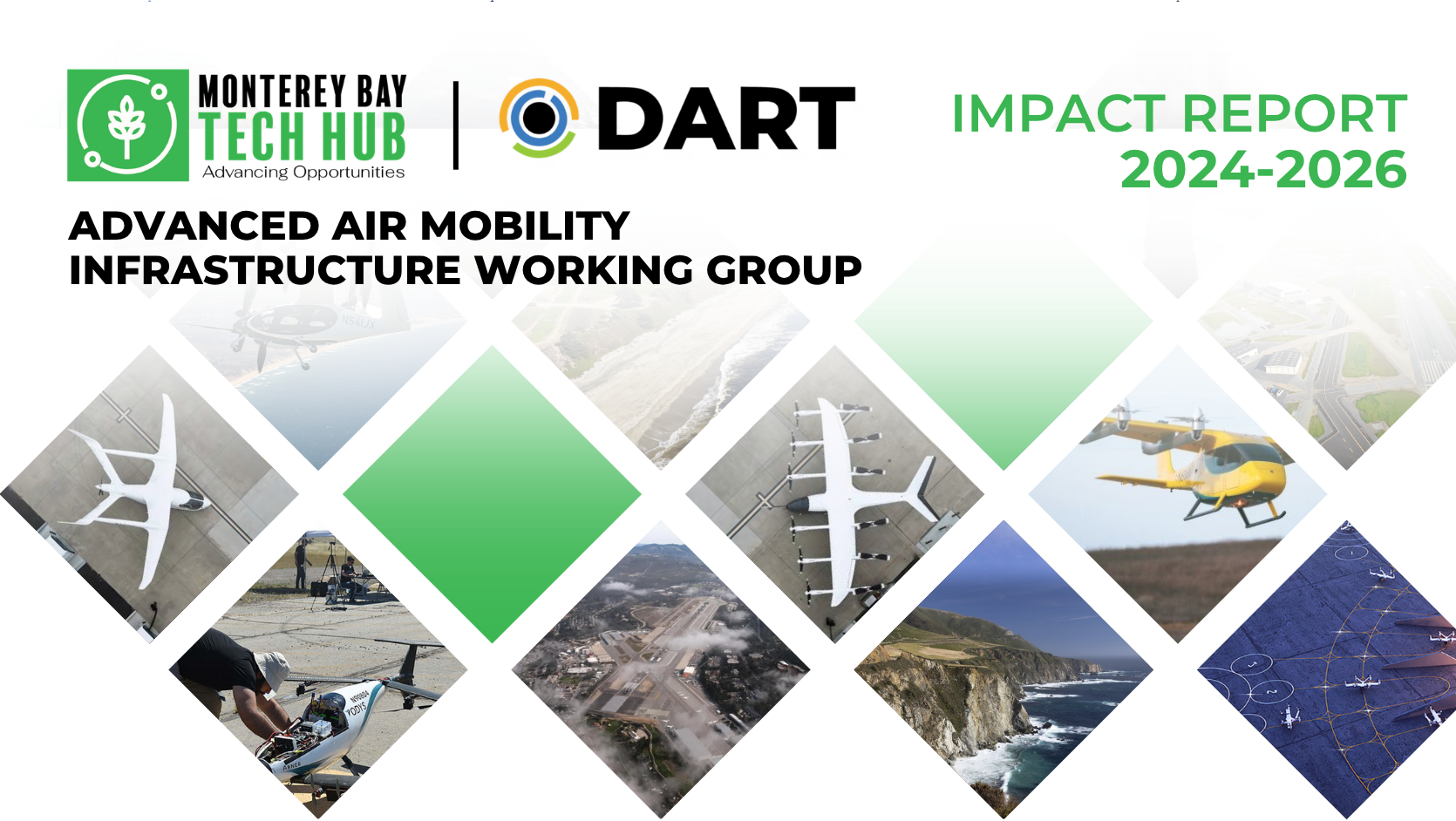
A National AAM Strategy — and a Clear Signal for Regional Action

The U.S. Department of Transportation has released its long-anticipated Advanced Air Mobility (AAM) National Strategy, marking an important milestone in aligning federal, state, and local efforts to responsibly integrate next-generation aircraft into the national airspace system. State aviation officials, through the National Association of State Aviation Officials (NASAO), have welcomed the strategy as a critical framework for collaboration, safety, workforce readiness, and infrastructure planning.
For Drone, Aviation & Robotics Technology (DART), the Strategy strongly validates the integrated, region-first approach we have been advancing across Workforce, Infrastructure, and Ecosystem development.
Workforce: Preparing People for the AAM Era
The National Strategy emphasizes that AAM success depends on a skilled, inclusive workforce—spanning pilots, technicians, operators, planners, and data specialists. This directly aligns with DART’s workforce initiatives, which focus on building accessible, career-connected pathways into advanced aviation and autonomy, particularly for historically underserved communities. Our programs are designed to ensure that emerging AAM opportunities translate into family-sustaining jobs and long-term regional prosperity.
Infrastructure: Planning Before the Aircraft Arrive
USDOT and state aviation leaders underscore the importance of early infrastructure planning—airspace integration, ground facilities, charging and energy systems, and community-compatible siting. DART’s infrastructure work reflects this guidance, supporting public agencies as they evaluate vertiports, test sites, and multimodal integration strategies that are safe, scalable, and aligned with regional transportation goals.
Ecosystem: Coordinated, State-Enabled Innovation
A central theme of the Strategy—and the accompanying NASAO response—is the essential role states play as conveners and integrators between federal policy, local communities, and industry. DART’s ecosystem-building model mirrors this logic: creating trusted spaces where public agencies, universities, industry partners, and community organizations can coordinate rather than compete.
This approach is currently taking shape through DART’s ongoing collaboration with Caltrans Division of Aeronautics, University of California, Berkeley, and the American Air Advantage Consortium to advance a competitive proposal under the FAA’s eVTOL Integration Pilot Program (eIPP). Together, we are demonstrating how state-enabled, regionally grounded partnerships can help the FAA test, learn, and scale AAM integration in ways that are operationally realistic and publicly accountable.
Why This Matters
As NASAO notes, the National AAM Strategy affirms that AAM will not be deployed by industry alone—it will succeed only through close coordination with state aviation agencies, transportation departments, and regional partners who understand local conditions and public priorities. DART is proud to be part of this emerging national alignment, translating federal vision into practical, place-based action here on the Central Coast and beyond.
We look forward to continuing this work with our partners and sharing updates as the eIPP process advances.