DART at the Doon Insights AAM Workshop: Why Community Is the Sector’s Most Underpriced Risk
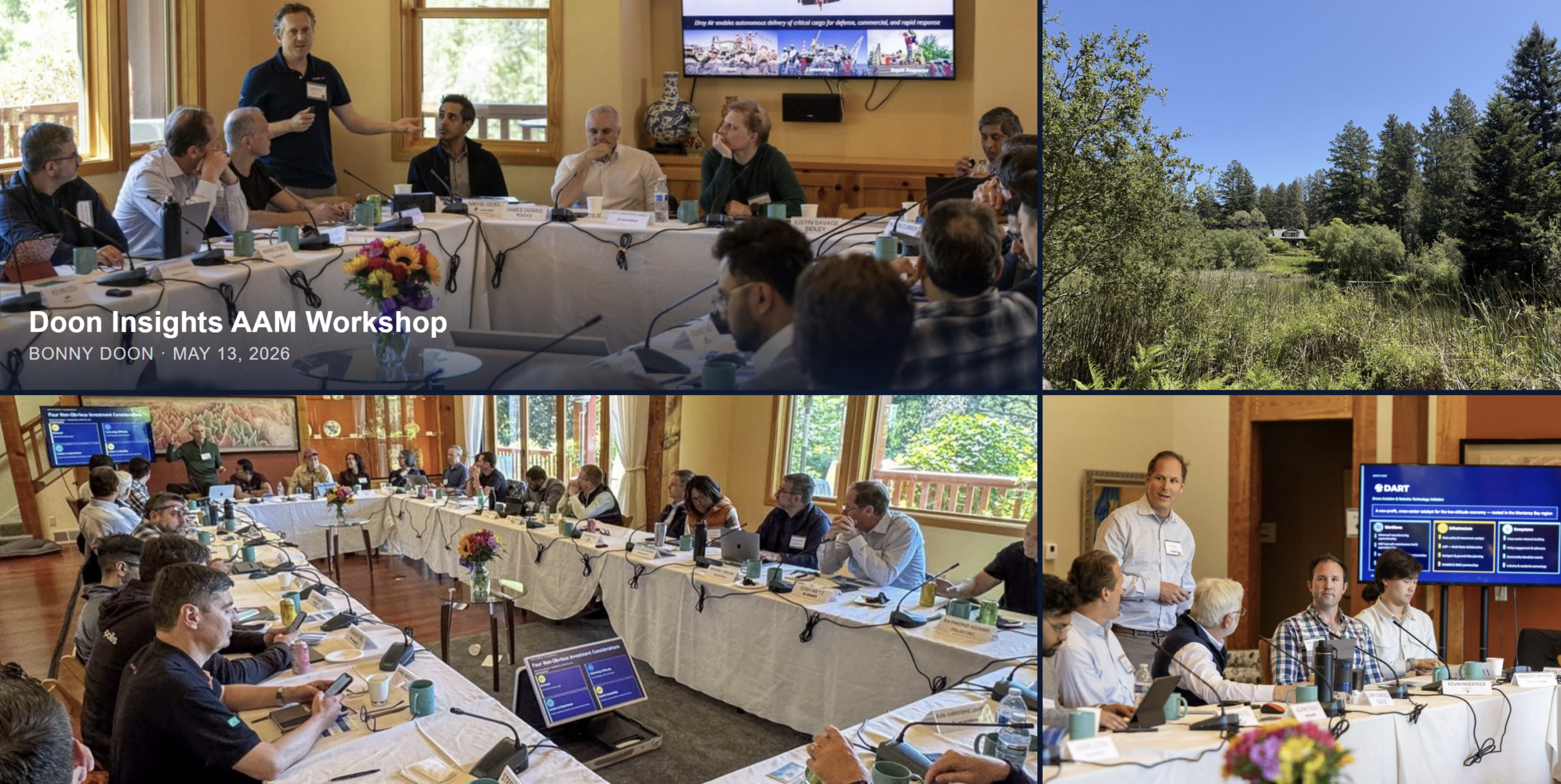
On May 13, DART Executive Director Josh Metz joined a select gathering of advanced air mobility (AAM) leaders at the Doon Insights AAM Workshop — an invitation-only convening of entrepreneurs, investors, legal strategists, and policy minds shaping the future of the low-altitude economy.
We are grateful to Howard Chao and the entire Doon Insights team for organizing and hosting what proved to be a candid, high-signal conversation across every dimension of the sector — challenges, opportunities, emerging markets, and technologies.
A Room Full of Perspective
The workshop brought together some of the most experienced voices in AAM — investors who have watched the capital cycle evolve, operators navigating certification and commercialization, legal minds working through the regulatory terrain, and policy thinkers mapping the institutional infrastructure the sector still needs to build. The range of perspectives was genuine, and the conversations were direct.
What stood out: broad recognition that the sector is moving faster than most predicted even two years ago. Aircraft are being certified. Revenue operations are beginning. The technology is arriving.
But a parallel set of questions is arriving with it — and those questions are not primarily technical.
DART’s Message: Human Infrastructure Is the Work
The most underpriced risk in AAM is not technical. It’s social.
DART carried a focused message to the workshop: the variables most likely to compress or extend timelines to scale are community trust, workforce readiness, and local political alignment — not battery chemistry or certification schedules.
These are the risks that don’t show up cleanly in a pro forma. They compound quietly — until they don’t. And unlike technical failures, you cannot iterate your way out of them in a lab.
The good news: there is a model that is working, right now, in Monterey Bay. DART’s programs across workforce development, community education, infrastructure policy, and ecosystem building offer a tested playbook for how operators, investors, and OEMs can close the gap between aircraft capability and community readiness.
What the Monterey Bay Model Shows
Open Doors Build Trust. Joby’s sustained community engagement at Marina Municipal Airport — an active public GA facility — demonstrates what transparency in practice looks like. Regular events, real engineers, direct answers to hard questions about noise and safety. That is not a PR program. It is a sustained practice that converts skeptics into stakeholders. You cannot buy that outcome; you have to earn it repeatedly over time.
Workforce Pipelines Are Political Infrastructure. DART’s advanced manufacturing apprenticeship has placed more than 100 Monterey Bay residents on pathways into the AAM sector. A new aircraft maintenance technician (AMT) apprenticeship is now underway. These programs are not charity — they are incentive architecture. When local workers and local economies have a visible stake in your growth, they show up at hearings. That is how policy gets made and how it holds.
Sustained Work Produces New Institutions. The Monterey Bay Tech Hub — launched in 2024 in partnership with UC Santa Cruz, DART, and the Monterey Bay Economic Partnership — is a direct product of this slow work. A cross-sector regional tech ecosystem spanning AAM, agtech, and the blue economy, the MBTH represents what years of relationship-building, community education, and workforce investment actually produces: new institutional infrastructure that extends the region’s capacity well beyond any single program or company.
The Cautionary Contrast. Amazon’s drone delivery launch in College Station, Texas offers the instructive counterpoint. The technology worked. The economic case was real. But community engagement infrastructure wasn’t built ahead of operations — and the friction that followed, around noise, safety, and privacy, persists years later. The lesson is simple: later is more expensive than early. Community trust compounds, in both directions.
The Four Priorities We Carried Into the Room
For the investors and operators in attendance, DART framed community engagement not as a communications function but as first-order infrastructure — and offered four practical priorities:
Fund engagement before you need it. Delayed engagement costs more, not less. This is an operations investment, not a marketing line item.
Build workforce pipelines ahead of the demand curve. The labor shortage is coming for this sector. Local hire programs are the hedge.
Design genuinely responsive feedback loops. Communities can tell the difference between a listening session and a rubber stamp. The distinction matters.
Hire for local relationship fluency. This skill set belongs on the org chart alongside technical and regulatory expertise — not as an afterthought.
The Slow Work Is a Competitive Advantage
The technology is not waiting for the community. That gap — between aircraft capability and community trust, workforce readiness, and local alignment — is the risk. The opportunity is to close it: deliberately, early, and with humility.
The Monterey Bay Tech Hub is proof that closing that gap compounds over time. What begins as workforce programming and community education becomes regional economic infrastructure — the kind that draws investment, anchors policy, and makes an entire sector more durable.
The slow work is not a soft consideration. It is the competitive advantage.
DART will continue doing that work in the Monterey Bay region and beyond. We are grateful for opportunities like the Doon Insights workshop that put these conversations at the table where capital, policy, and operations intersect.
Learn more about DART’s workforce, infrastructure, and ecosystem programs at mbdart.org.