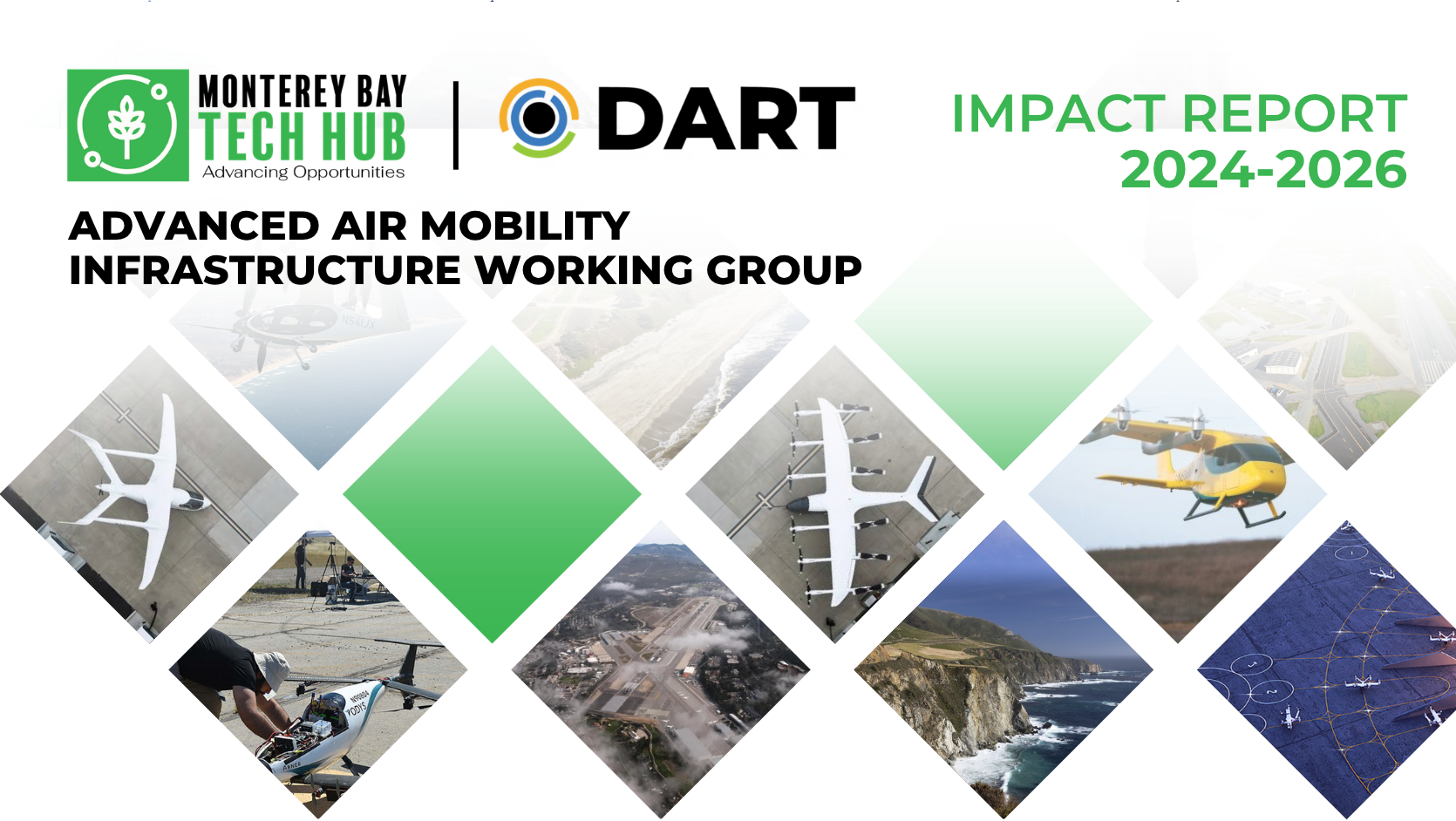
Defining the “Low Altitude Economy”

Defining the “Low Altitude Economy”: How DART is Catalyzing California’s Next Great Innovation Frontier
Across the Central Coast and beyond, a new layer of economic activity is emerging—one that exists between the ground and 5,000 feet above it. This space, often referred to as the “low altitude economy,” represents one of the most dynamic frontiers of innovation and investment in California today. From uncrewed aerial systems (UAS) and advanced air mobility (AAM) to automated agriculture, robotics, and digital infrastructure, the low altitude economy is transforming how communities connect, produce, and thrive.
What Is the Low Altitude Economy?
The low altitude economy encompasses the technologies, infrastructure, workforce, and policies that enable sustainable, intelligent operations within near-earth airspace. This includes:
- Advanced Air Mobility (AAM) — electric and autonomous aircraft systems providing new passenger and cargo services between communities;
- Uncrewed Aerial Systems (UAS) — drones delivering agricultural insights, mapping data, and public-safety support;
- Automation and Robotics — technologies that extend precision, safety, and efficiency from farms and factories into the sky;
- Digital and Energy Infrastructure — advanced communications, navigation, and clean-power systems that support the safe integration of aerial and ground-based innovation.
Collectively, these sectors form an ecosystem that will generate thousands of high-wage jobs, enable faster and cleaner mobility, and expand economic opportunity in both urban and rural regions.
Why “Low Altitude” Fits DART’s Focus
DART (Drones, Aviation and Robotics Technology) has been advancing the low altitude economy since its founding. DART’s sector focus sits squarely at the intersection of aviation, automation, and community development—bridging the innovation happening at local airports, educational institutions, and technology firms with the needs of local governments and regional workforce systems.
Through partnerships with OEMs, state and regional partners, DART is helping shape real-world demonstrations of eVTOL passenger and cargo services, vertiport network plans, flight-testing corridors, and airport readiness strategies. Together, we’re helping define and deploy the next generation of California’s advanced air mobility infrastructure.
Meanwhile, DART’s workforce programs—such as the DART-Joby Advanced Manufacturing Apprenticeship Program, Aircraft Maintenance Technician Apprenticeship, and DART-PVUSD RV-12 Airplane Build Lab —are training the next generation of technicians and operators needed to sustain this rapidly growing ecosystem.
A Platform for Inclusive Prosperity
Defining and developing the low altitude economy isn’t just about advanced aircraft—it’s about people, place, and purpose. DART’s work ensures that this next generation of innovation creates equitable access to high-quality jobs, supports resilient local supply chains, and strengthens community well-being across the Central Coast.
By convening industry, education, and public partners through events like the LIFT Summit, and regional working groups, DART is helping to establish California’s Central Coast as a global leader in low altitude innovation—an economy that connects the sky to the ground, and technology to opportunity.
Learn More
To explore how DART and its partners are building the low altitude economy, visit MBDART.org and follow us on LinkedIn.