Monterey Bay DART Publishes Monterey-San Jose Air Taxi Case Study
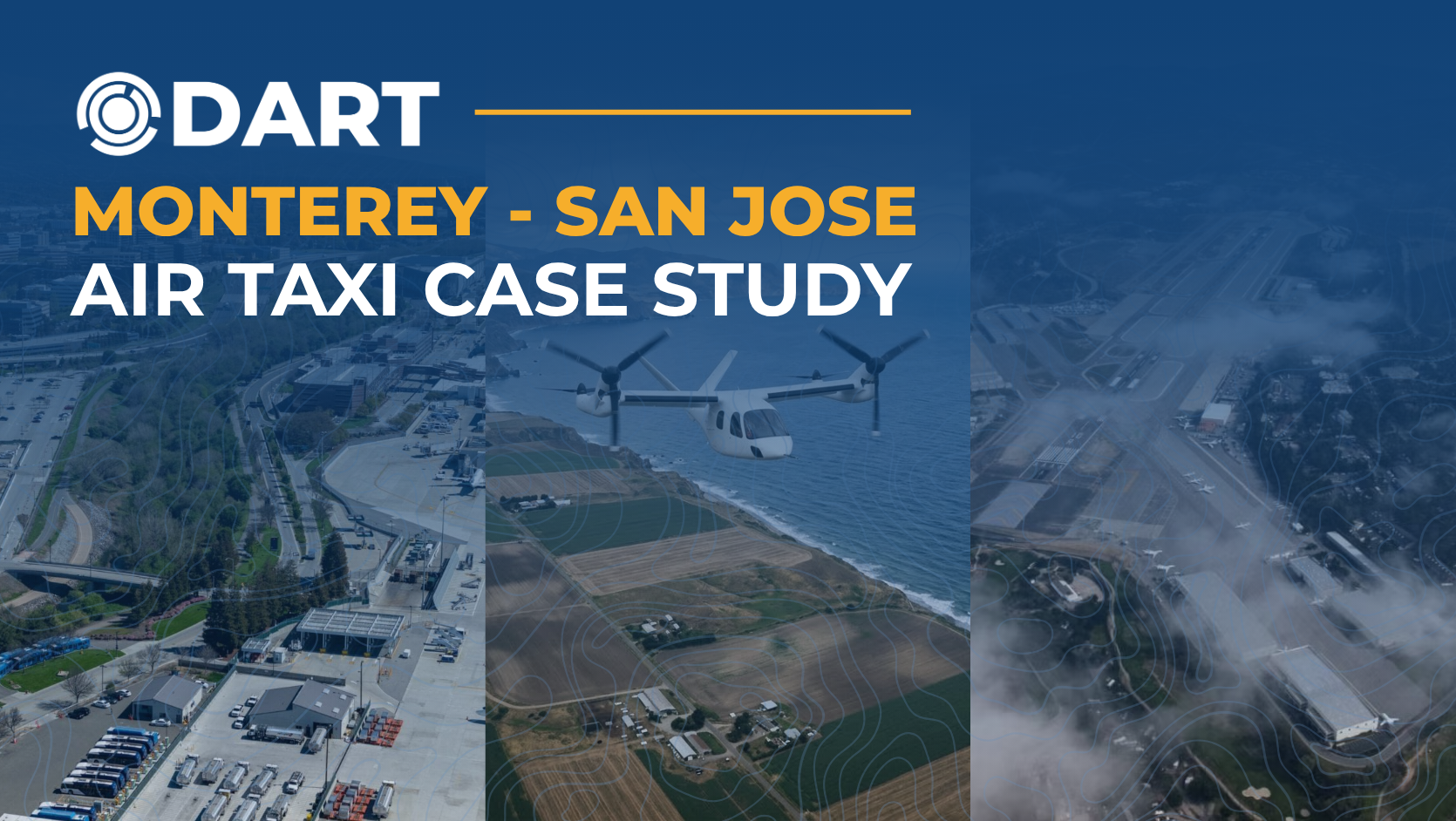
MONTEREY, Calif. — Monterey Bay Drone, Aviation & Robotics Technology (DART), a nonprofit dedicated to advancing Advanced Air Mobility (AAM) infrastructure and workforce development, today released the Monterey–San Jose Air Taxi Case Study, an in-depth look at what an early commercial electric air taxi route between Monterey Regional Airport (MRY) and San Jose Mineta International Airport (SJC) would mean for the Monterey Bay Region.
The case study models Joby Aviation’s S4 aircraft against ground-based ridesharing and household vehicle travel across a hypothetical 67-mile corridor, evaluating the route on travel time, climate impact, cost, and weather reliability. It is intended to give public planners and regional stakeholders a view of the benefits and current limitations of air taxi service as the AAM industry matures toward market entry.
Key findings include:
- Travel time: Under the selected Visual Flight Rules route, air taxi service could complete the trip in 30 minutes, compared to 97 minutes by car in free-flow traffic and 122 minutes during peak hours — up to four times faster, saving riders 1 to 1.5 hours each way. However, this figure does not include time involved for passenger handling.
- Climate impact: At typical vehicle occupancy for each mode, air taxi service would cut per-passenger emissions by roughly two-thirds compared to a standard gas-powered vehicle, though it would still produce more than double the emissions of a comparably occupied all-electric vehicle.
- Cost of service: At current industry pricing estimates, a seat on the air taxi route would cost $247 — about twice the cost of a standard on-demand rideshare and more than six times the cost of driving a personal vehicle.
- Weather: Monterey’s coastal marine layer means the region sees Instrument Flight Rules conditions on roughly 40% of days, more than four times the rate at San Jose, a factor that could affect service reliability in early operations.
“This air taxi route has clear advantages in time and emissions, but our findings also show that cost and weather reliability are two challenges that will impact the use of these services,” said Jordan King, Project Analyst at DART and lead author of the report. “Our goal with this case study is to help planners and policymakers see both sides clearly as they prepare for Advanced Air Mobility.”
“Monterey Regional Airport has always been a gateway for our community, and Advanced Air Mobility offers an exciting opportunity for MRY to further that mission in the years to come,” said Chris Morello, Executive Director of Monterey Regional Airport. “As the industry matures, we are encouraged by the potential to enhance regional connectivity and contribute to broader travel opportunities for Central Coast residents and visitors.”
The report also outlines the infrastructure investment needed to support commercial air taxi operations, and identifies priority areas for future analysis, including passenger demand modeling, multi-vertiport network planning, and evaluation of additional AAM aircraft types.
DART developed the case study with input from BETA Technologies, Caltrans Division of Aeronautics, Joby Aviation, Monterey Regional Airport, San Jose Mineta International Airport, and Skyway Technologies. The analysis draws on DART’s in-house AAM operations modeling capabilities, developed to support corridor-level feasibility work like this study.
About DART
Monterey Bay Drone, Aviation & Robotics Technology (DART) is a nonprofit founded in 2019 whose mission is to build innovative pathways to meet Advanced Air Mobility’s growing workforce needs, support the planning and development of critical infrastructure, and convene stakeholders across industry, government, and education to unlock regional potential. DART has been an advocate for Advanced Air Mobility (AAM) in the Monterey Bay Region, including helping Joby Aviation secure a $9.8 million CalCompetes grant for a manufacturing footprint in Marina, California, and serving as a core partner in the development and award of $7.45 million in state funding for the California Advanced Air Mobility Corridors Initiative to enable further research and development in Monterey Bay through the Monterey Bay Tech Hub.
Media Contact
Jordan King
Project Analyst, Monterey Bay DART
jordan@mbdart.org | info@mbdart.org