Four Years In: How AMAP Opened the Door, and What It Keeps Making Possible
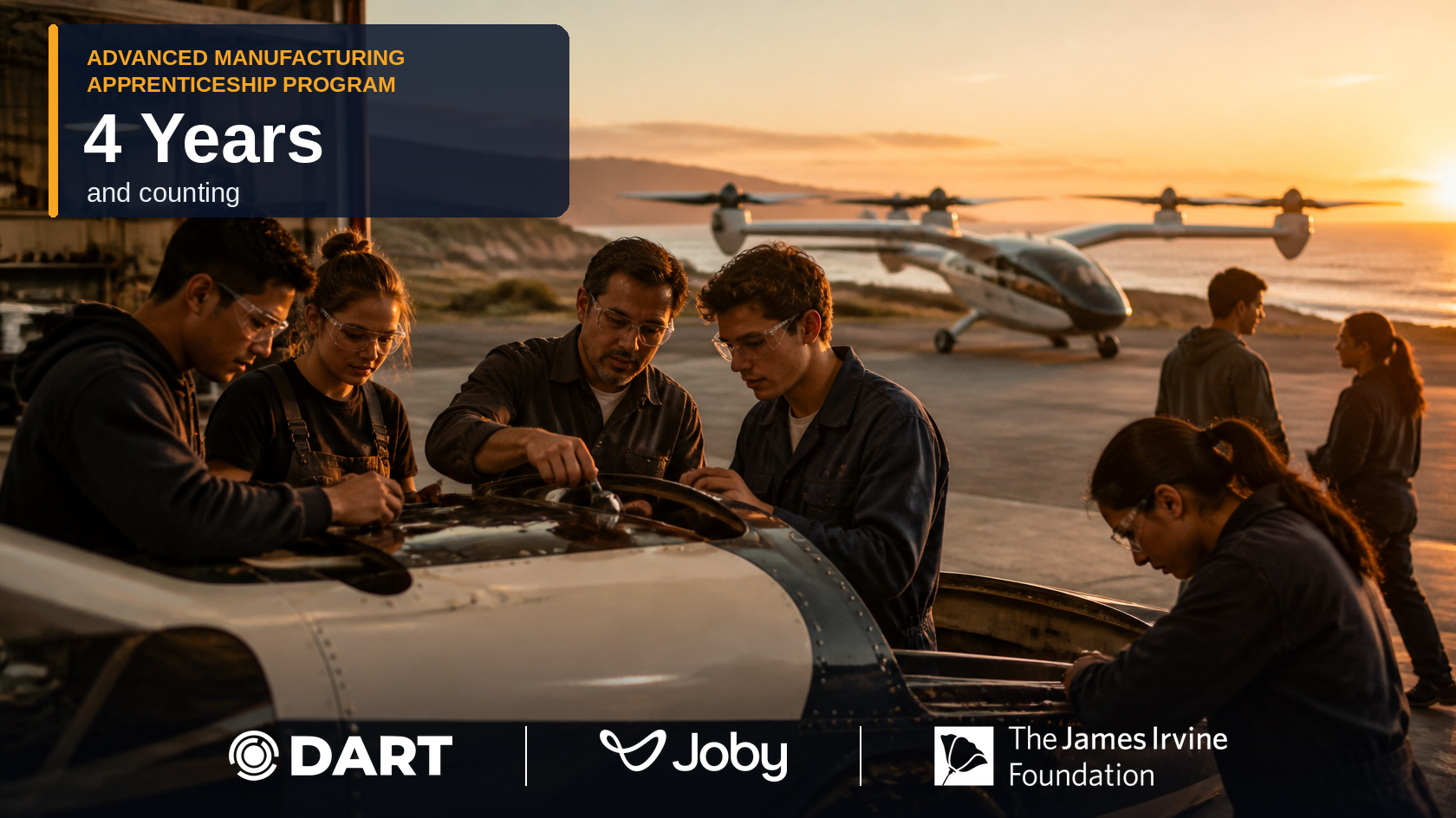
What started as a 20-seat pilot at Joby Aviation has become a working model for how the Monterey Bay region trains, hires, and builds careers. It is also the foundation for the programs that followed.
In the fall of 2022, Monterey Bay Drones, Aviation & Robotics Technology (DART) and Joby Aviation launched the Advanced Manufacturing Apprenticeship Program (AMAP) to answer a simple question. Could a region with more than 140,000 job-seekers and no pipeline into aerospace build one with the community, rather than around it?
The answer is now documented, and it keeps growing. Here is where AMAP stands today and what it has set in motion.
A Quick Look Back
AMAP is a paid, earn-and-learn apprenticeship at Joby’s Marina manufacturing site, designed for people with no aerospace experience. Community-based organizations such as SIEDI, Mujeres en Acción, Rancho Cielo, Digital NEST, and the Monterey Black Caucus recruit and support candidates. Early support from the James Irvine Foundation covered the wages of the first 20 apprentices, which lowered the risk for Joby while the company weighed sites nationally. Joby matched that investment by funding 40 more.
What the Results Show
When we announced the 2024 call for applications, 23 apprentices had been enrolled from more than 200 applicants. The fuller record now looks like this:
- First cohort (2022–23): 220+ applicants for 20 paid seats. 80% completed, 13 apprentices were promoted to permanent technician, and median wages rose 22% within a year. Every hire had no aerospace manufacturing experience, half held only a GED or high school diploma, and 15% were veterans.
- Second cohort (2024): 300+ applicants, 36% more than the first cohort. Joby made 23 offers, all accepted, and 39% of the cohort were women, up from 2 of 20 in the first. Through early 2024, AMAP had supported 60 apprentices (20 funded by Irvine and 40 by Joby), with more than 90% moving into permanent positions.
- Today: Now a proven model, Joby began to invest heavily in expanding AMAP under its own funding. By May 2025, Joby was reporting AMAP as its primary entry-level hiring pathway. Joby’s own count of AMAP hires now exceeds 200 apprentices.
What Each Cohort Taught Us
The Talent Rewire case study captured AMAP’s design for employers elsewhere to adapt. The program’s own lessons are just as useful:
Hire directly. Early apprentices started through a staffing agency and missed Joby’s orientation and mission. Joby moved to direct hire with benefits from day one, and that is now its approach to entry-level roles.
Meet candidates where they are. Email invitations caused no-shows among candidates with limited digital access, so scheduling moved to text messaging. Community partners now run mock interviews and résumé workshops, like the AMAP Readiness Workshop DART co-hosted with Joby and the Monterey County Black Caucus in Marina.
Support the learning. Ad hoc on-the-job training gave way to classroom instruction, assigned mentors, designated trainers, and scheduled reviews. Joby also dropped third-party certificates in 2024 in favor of job-specific skills.
AMAP is now aligned with a US Department of Labor (DOL)-registered apprenticeship, making it easier to scale the program.
What AMAP Set in Motion
AMAP’s impact reaches well beyond the hiring floor. DART coordinated the Monterey Bay Joby Aviation Working Group that helped make Joby’s Marina expansion shovel-ready. The effort contributed to a $9.8 million CalCompetes award, 690 additional California jobs committed by Joby, and more than $30 million in new facilities and equipment in Marina. AMAP also helped make the case for SB 800, which created a state advisory panel on advanced air mobility infrastructure.
Success also created demand for what comes next. Three DART programs now build on what AMAP proved.
The Aircraft Maintenance Technician Apprenticeship (AMTA). On November 17, 2025, AMTA launched at Joby as an 18-month earn-and-learn program aligned to the FAA Airframe and Powerplant (A&P) exams. Irvine funding gave DART the capacity to design and secure the program, and a $300,000 California Jobs First Catalyst grant covers apprentice wages. We intentionally started with three apprentices, and all three have stayed with Joby. One earned A&P certification early on the strength of prior experience, and two moved into other Joby roles they wanted, which opened seats for new entrants. A USDOL regional visit to the apprentices in Watsonville followed on June 11, 2026, and the next cohort is recruiting.
“I didn’t even know this kind of career was an option.” — AMTA apprentice
The FAST Aircraft Build Lab. The FAST pathway, created with Pajaro Valley Unified School District, has students building a full-scale Van’s RV-12iS at Watsonville Municipal Airport. It is the same aircraft type used in AMTA training. Twenty-one students completed year one and 25 are enrolled for year two. They have built the vertical stabilizer, rudder, anti-servo tab, stabilator, and fuselage center section. The Irvine Foundation funded the aircraft kit, and PVUSD funds instructors, hangar, and insurance. EAA Chapter 119 volunteers mentor students at the bench.
MsUAS Pathways. Working with Hartnell College and supported by Irvine, MsUAS Pathways takes AMAP’s community-first approach into drones. The program aims to serve 150 participants and prepare at least 50 for FAA Part 107 certification. It includes community-based on-ramps in Seaside with the Monterey County Black Caucus, a veteran and military-connected pathway, and employer engagement.
One Airfield, One Pathway
Together, these programs form a ladder: FAST introduces high school students to aircraft construction, and AMTA and AMAP offer paid apprenticeships into maintenance and manufacturing careers. The handoffs are designed but not yet measured. FAST’s first completers will reach the pathway after the 2026–27 school year, and we are working with Joby to track transitions between programs.
“The hiring challenges and growing pains we faced made us more open to doing things differently. AMAP has been instrumental in helping us source and train local talent.” — Peter Church, DART (formerly Joby Aviation via the AMAP Case Study)
What’s Next
AMAP started with a conversation, a small grant, and employers willing to do things differently. Four years later, it has helped shape a regional system where a student can start building an airplane in high school and a career changer can earn while learning at one of the region’s most closely watched aviation employers.
Learn more about DART’s workforce programs at mbdart.org/programs/workforce-development.